Positive-Locking Fold-Flat Travel Hanger
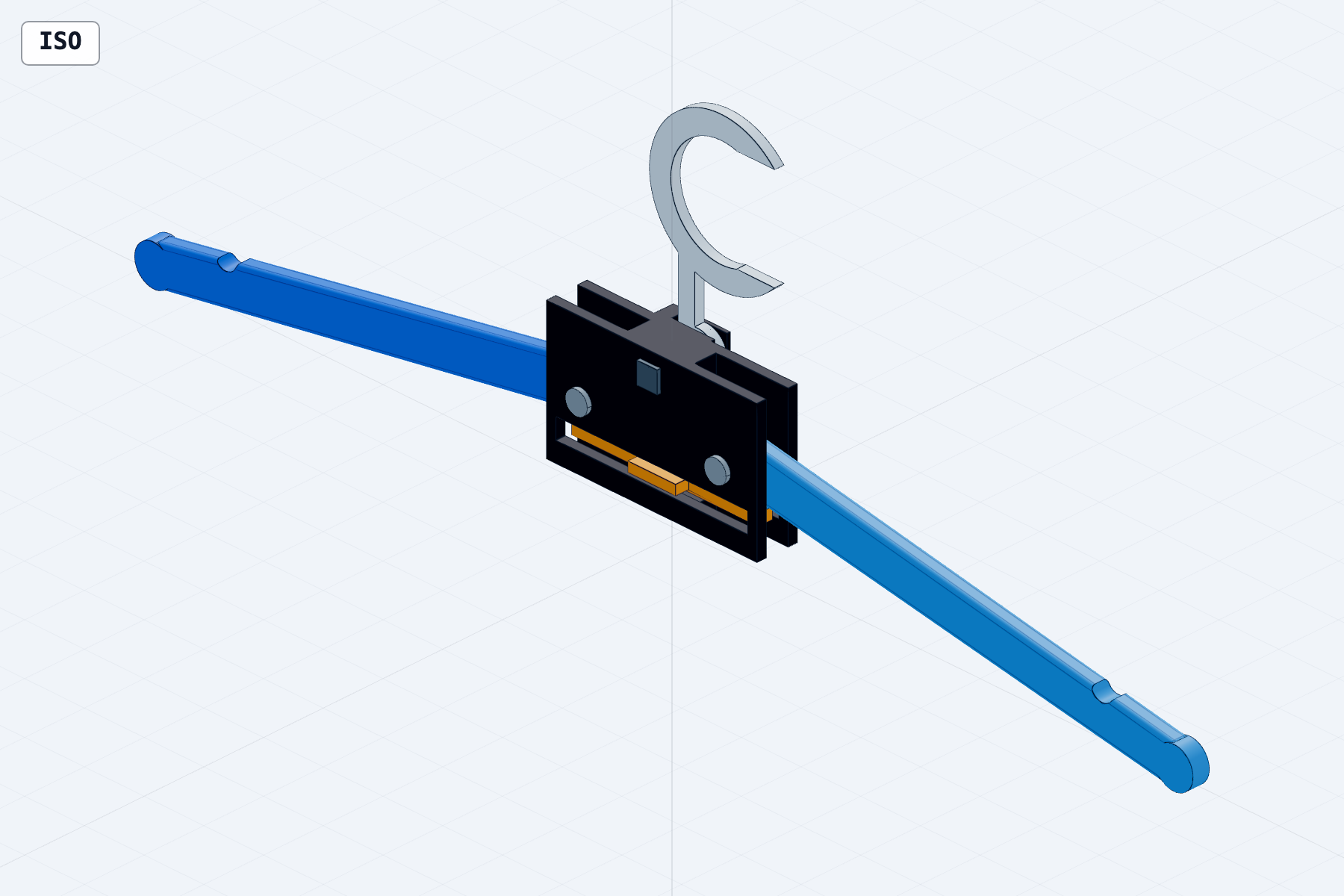
This one-shot cleanroom result is a compact, parametric travel hanger with a linked positive-lock mechanism, five modeled fold poses, printable part exports, and a named Burr animation. It is published as a repair-required digital pre-build: the exact CAD evidence is strong, while Burr's tessellated interference result and every physical-performance claim remain unresolved.
How it was made
The publisher’s ingredients and steps. Unlisted details are unknown. Copy this text kit to your agent to adapt it.
Models
- GPT-5.6 · OpenAI · execution · Codex
Agent
Codex
Pinned skills
- fraylabs/burr/skills/burr ↗Commit
3a1b8ebf17e178b28c6d65f67ad04fc97f009a55 - earthtojake/text-to-cad/skills/cad ↗Commit
fc4f7069fb31c131a55f1ecd334b505f031f486b
References
- Published brief and result ↗document
Existing result context and its stated limits.
- Recorded execution prompt ↗document
Original reusable prompt; preserved unchanged.
- RUN_REPORT.md ↗document
Published evidence used to reconstruct the ordered workflow.
- PUBLICATION_REVIEW.md ↗document
Published evidence used to reconstruct the ordered workflow.
- LIMITS_AND_TEST_PLAN.md ↗document
Published evidence used to reconstruct the ordered workflow.
Tools and APIs
- Burr
Inspect the portable project, named fold motion and retained interference results.
- CAD provider
Generate parametric parts and validate exact STEP geometry across the five fold poses.
Ordered steps
Start the documented cleanroom run
Reconstructed workflow from the published prompt and available result artifacts; this is not a recorded sequence of agent turns. Give an isolated Codex agent the unchanged prompt, pinned Burr and routed CAD skills, and an empty workspace, as recorded in the run report.
Build the mechanism and motion
Generate the five printable parts, purchased-hardware envelopes, fold poses and engaged/released lock details, then configure the named Fold hanger motion.
Keep both validation results
Check all final CAD targets and pairwise STEP intersections in five poses. Preserve Burr’s failed/incomplete interference results alongside the exact geometry evidence.
Review the known repair
Read the publication review: the assembly guide’s spring guide pegs are missing from the source. Keep the result repair-required and run the physical test plan before any use; geometry does not establish a load rating.
About
This one-shot cleanroom result is a compact, parametric travel hanger with a linked positive-lock mechanism, five modeled fold poses, printable part exports, and a named Burr animation. It is published as a repair-required digital pre-build: the exact CAD evidence is strong, while Burr's tessellated interference result and every physical-performance claim remain unresolved.
An isolated Codex agent received only the exact prompt in prompt.md, the Burr skill, its routed CAD provider, and an empty workspace. The parent agent did not supply an earlier hanger design or steer the run after it began.
What the run produced
- Five printable parts: center yoke, left and right shoulder arms, folding hook, and linked dual-positive-lock bar.
- Purchased-hardware envelopes for M5 shoulder screws and low-profile locknuts.
- Deployed, 25%, 50%, 75%, folded, exploded, lock-engaged, and lock-released STEP assemblies.
- Printable STL and 3MF exports for all five polymer parts.
- A portable Burr project with a 1.6-second
Fold hangermotion. - CAD, Burr, and machine-readable validation evidence.
The deployed assembly is 442 mm wide. Its folded envelope is 222.885 × 88 × 30 mm. Each shoulder heel has 6 mm of modeled engagement with the linked lock bar, and releasing the bar provides 7.5 mm of travel with 1 mm of modeled blocking-face clearance.
What is actually verified
- All 16 final CAD targets passed the provider's topology, closure, and positive-volume validation.
- An independent exported-STEP verifier checked all 55 component pairs in each of five fold poses and found no positive-volume intersections.
- The deployed and folded exports preserve the same 11 named component occurrences.
- Burr loaded both endpoints and generated a 61-frame rigid motion across all 11 instances.
Burr's own interference result is not clean. It reports four deployed findings and three folded findings, and it cannot prove closure for seven tessellated components. Those failed/incomplete results are included unchanged alongside the separate exact-STEP evidence; neither result is used to erase the other.
Repair-required boundary
No hanger was fabricated or physically tested. The geometry does not prove a 3 kg rating, stiffness, fatigue life, creep resistance, spring behavior, pin retention, dimensional accuracy, pinch safety, garment safety, or production readiness. The supplied test plan requires progressive symmetric and asymmetric loading, folding cycles, release-force tests, drops, warm-creep exposure, process coupons, and edge/snag review before use.
Publication review also found that the generated assembly guide tells the builder to fit two compression springs over guide pegs, but the generated lock-bar source contains no guide pegs. The spring-loaded return and folded-retention assembly therefore cannot be built as documented. This source-level defect is preserved rather than silently repaired so the outcome remains an authentic one-shot result; see artifacts/docs/PUBLICATION_REVIEW.md.
Extract the project archive, change into the extracted project root, and run burr .. Its sources and validation receipts remain editable and inspectable. The downloadable archive's motion configuration was migrated after the cleanroom run to Burr 0.34's single-source joint format; its CAD, original report, and validation receipts remain unchanged.
Exact prompt
Hidden characters, if present, appear as Unicode escapes$burr
Design a durable, fold-flat travel clothes hanger for adult shirts, trousers and lightweight jackets. It must open to a normal full-size hanger, fold into a compact package without loose pieces, and positively lock when deployed so garment weight cannot collapse it. Treat this as a complete mechanical product concept, not merely a recognizable hanger-shaped model.
Use Burr as the project environment and the installed mechanical CAD provider for authoritative parametric source, STEP generation and validation. Keep all source, models and evidence inside one portable project folder. Do not add electronics.
## Product requirements
Use millimetres.
Design targets:
- Deployed shoulder width: 430–450 mm.
- Folded envelope: no larger than approximately 230 × 90 × 30 mm.
- Hook must accept closet rods up to 38 mm diameter and retain the hanger during ordinary handling.
- Design intent: carry up to 3 kg of clothing without relying on visibly thin, flexible plates. This is a geometry target only, not a validated load rating.
- Every prototype part must fit within a 256 × 256 mm FDM build area in a sensible print orientation.
- No detachable pieces during normal folding, deployment or use.
Use a symmetrical articulated structure with named left and right components. Load-bearing shoulder links must have credible beam depth, ribs or box-like sections; do not use flat decorative strips that would obviously flex. Round garment-contact edges, avoid sharp corners, and include practical strap notches without weakening the primary load path.
## Locking and folding mechanism
The deployed hanger must use a positive mechanical lock. Friction, hinge tightness or a weak detent alone is not an acceptable deployed lock.
Design the mechanism so that:
- Downward garment loads react through hard stops and positive blocking faces.
- A deliberate thumb action is required to release the deployed lock.
- The release cannot be triggered by the normal downward or inward load of clothing.
- Both sides are locked, either through one central locking control or two mechanically linked locks.
- Locking engagement is visible and inspectable in the CAD.
- Locking faces have at least 3 mm of modeled positive engagement unless a stronger documented geometry is used.
- The arms also have a light folded-position retention feature so they do not swing open in luggage.
- Hinge pins are captive after assembly. Prefer standard metal dowel or shoulder pins where appropriate; printable substitutes may be included but must be clearly identified as prototype-only.
- Pin, bore and axial clearances are explicit source parameters. Choose credible prototype clearances and explain them.
- Fingers are protected from obvious pinch points during the final part of deployment and folding.
The deployed hard stops—not the release tab or a flexible snap feature—must carry the primary garment load. Do not hide an impossible latch inside overlapping solids.
## Authoritative CAD and deliverables
Create editable parametric CAD source with named dimensions, joints, mating datums and component labels.
Deliver:
1. Individual editable part sources.
2. Individual STEP files for every manufactured part.
3. STL or 3MF prototype exports for printable parts.
4. A complete deployed STEP assembly.
5. A complete folded STEP assembly.
6. Intermediate 25%, 50% and 75% fold-pose STEP assemblies for clearance inspection.
7. An exploded assembly showing pins, links, lock components and assembly order.
8. A close-up lock-detail assembly in both engaged and released states.
9. A concise BOM and assembly note identifying printed parts and purchased pins or springs.
10. A `.burr/config.toml` that scopes the final model folder and configures a named Fold hanger motion between the deployed and folded assemblies.
The deployed and folded Burr motion endpoints must contain the same uniquely named components with unchanged geometry and only different rigid transforms. Keep the motion assembly below Burr’s component limit.
## Validation
Validate all final STEP artifacts as closed, positive-volume solids. Report component counts, overall bounds and individual part envelopes.
Programmatically verify:
- Deployed and folded target envelopes.
- Hook opening and throat clearance.
- Pin-to-bore and axial clearances.
- Positive lock-face engagement.
- Hard-stop contact geometry.
- Clearance around the release control.
- Every printable part fits the stated build area.
- No unintended positive-volume intersections in the deployed, folded and three intermediate poses.
- The deployed and folded assemblies contain identical named component geometry for Burr motion playback.
Open the project in Burr, verify the named motion loads and plays, and inspect both endpoints in Solid and X-ray modes. Run Burr’s supported interference check on the deployed and folded assemblies. If detailed STEP tessellation prevents a clean result, report `Incomplete` honestly; a documented simplified collision envelope may be added only as secondary evidence and must never be described as the exact design.
Save reviewed snapshots of:
- Deployed isometric and front views.
- Folded isometric view.
- Exploded assembly.
- Lock engaged.
- Lock released.
- One intermediate fold pose.
- Burr Solid and X-ray views.
Repair source-level geometric or visual failures and regenerate affected outputs before finishing.
## Limits and physical test plan
This is a digital pre-build. Do not purchase parts, fabricate the hanger or claim that strength, fatigue life, creep, impact resistance, latch reliability, print quality or garment safety has been physically validated.
State the physical tests required before use, including:
- Progressive static load testing at the hook and both shoulders.
- Asymmetric one-arm loading.
- Repeated folding and locking cycles.
- Lock-release force and accidental-release testing.
- Hinge and pin-retention testing.
- Drop testing in the folded state.
- Warm-environment creep testing.
- Pinch-point and garment-contact edge inspection.
Return the authoritative source paths, generated models, Burr version and URLs, validation results, screenshots, remaining failures and unsupported claims. A visually attractive result is not complete unless the lock and load path are mechanically understandable.Download the result
- ZIPComplete portable Burr project↓
- SHA-256Prompt and primary artifact hashes↓
- PythonShared parametric hanger source↓
- STEPDeployed assembly↓
- STEPFolded assembly↓
- STEPExploded assembly↓
- STEPPositive lock engaged detail↓
- STEPPositive lock released detail↓
- MarkdownCAD and mechanism brief↓
- MarkdownBill of materials↓
- MarkdownAssembly and operation guide↓
- MarkdownLimits and physical test plan↓
- MarkdownCleanroom and independent review report↓
- MarkdownPublication review and known source defect↓
- JSONExact geometry validation summary↓
- JSONCAD provider validation summary↓
- JSONBurr deployed interference result↓
- JSONBurr folded interference result↓
- PNGBurr folded motion endpoint↓
- PNGBurr deployed failed check evidence↓
Technical details and provenance
- Provider
- OpenAI
- Model
- GPT-5.6
- Agent
- Codex
- Published
- Publication
- community