Two-Angle Desk Phone Stand
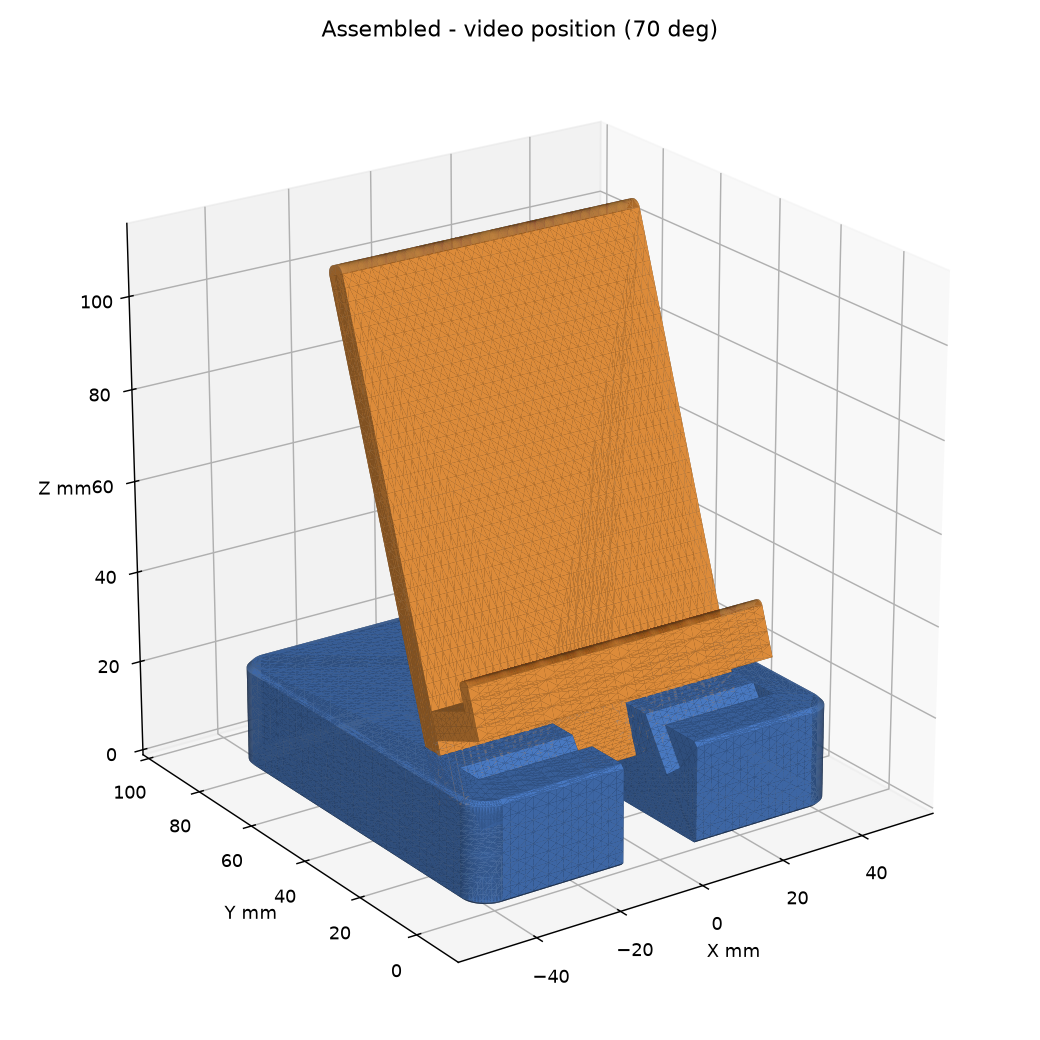
A desk phone stand in two printed parts with no screws or glue: a solid 88 × 88 mm base with two angled sockets, and an L-shaped cradle that drops into either one. The front socket sets a 55° reading angle and the rear socket a 70° video-call angle. A slot through the cradle's ledge and a notch in the base let the charging cable stay plugged in, leaving forward over the desk or backward through a channel underneath. It fits phones 65–80 mm wide and up to 11 mm thick in a case, and both parts print in PLA without supports.
How it was made
Captured locally, then reviewed and possibly edited by the creator. This is a shared recipe, not an unedited transcript. Copy this text kit to your agent to adapt it.
- Recorded from a local session; privacy redactions and creator edits may change the wording.
- Tool outputs and file contents were omitted. Unknown ingredients are not inferred.
- Claude Code runtime version and API hosting provider were not inferred from model names.
- Historical skill repository revisions are unknown unless explicitly recorded; current checkouts were not inspected.
- 11 reference ingredients were detected; only shareable URLs retained below are included.
Models
- claude-opus-5-5 · anthropic · execution · Claude Code
Agent
Claude Code
Tools and APIs
- CadQuery
Model both parts parametrically and export the STEP and STL files.
- trimesh
Check interference, phone and plug clearances, watertightness and overhangs on the meshes.
- matplotlib
Render the assembled, side, exploded and base views.
- Write
Write the parametric model, the check and statics scripts and the report.
- Read
Check the renders and check results between fixes.
- ToolSearch
Load the job tool used to run the build and report the result.
- Possible job runner
Receive the brief, run the CAD build, checks and renders on a remote machine and hand back the result.
Ordered steps
Hire Prototype Engineer with a three-part brief
Fill in the agent's brief: what it should be, the sizes, loads and limits, and how it will be made. The agent designed, checked and documented the part without follow-ups.
What should it be? A desk phone stand that holds a phone at two viewing angles (for video calls and for reading), with a slot so the charging cable can stay plugged in.

Sizes, loads and limits: fits phones 65–80 mm wide and up to 11 mm thick, including in a case; stays put when tapping the screen; footprint under 90 × 90 mm.

How will it be made? FDM printing in PLA on a 220 mm bed, without supports, and no screws or glue.
About
A desk phone stand in two printed parts with no screws or glue: a solid 88 × 88 mm base with two angled sockets, and an L-shaped cradle that drops into either one. The front socket sets a 55° reading angle and the rear socket a 70° video-call angle. A slot through the cradle's ledge and a notch in the base let the charging cable stay plugged in, leaving forward over the desk or backward through a channel underneath. It fits phones 65–80 mm wide and up to 11 mm thick in a case, and both parts print in PLA without supports.
How it was made
An AI agent made this. Prototype Engineer, Possible's hireable agent running Claude Code with Claude Opus 5.5, got the brief in this recipe and nothing else: a fresh, empty workspace and no follow-ups. It wrote a parametric CadQuery model, then built, checked and rendered it on a remote Linux machine. The final build passed all 50 of its geometry checks: valid solids, no interference in either position, three phone sizes and a charging plug clear of the parts, footprint, bed size and overhangs. It dropped an earlier hinged-kickstand concept after its own statics showed the hinge would lift under a large phone. Possible recorded the session with possible capture. Nobody edited the model by hand.
What to know
This is a digital pre-build only. Nothing has been printed or measured. The tap-stability figures are calculations from an assumed 1 N tap and an assumed desk friction of 0.3; with a solid base the margin near the top of a large phone is thin, and at lower infill a tap there could tip it. The two angles and the plug size are the agent's assumptions, and the report lists the physical tests needed before relying on it. The renders are plain mesh plots, not photorealistic. The brief is public; the agent's standing instructions are not. Results vary between runs.
Exact prompt
Hidden characters, if present, appear as Unicode escapesWhat should it be? A desk phone stand that holds a phone at two viewing angles (for video calls and for reading), with a slot so the charging cable can stay plugged in.
Sizes, loads and limits: fits phones 65–80 mm wide and up to 11 mm thick, including in a case; stays put when tapping the screen; footprint under 90 × 90 mm.
How will it be made? FDM printing in PLA on a 220 mm bed, without supports, and no screws or glue.What you need
- Claude Code, or another coding agent that can write files and run Python
- CadQuery, trimesh and matplotlib to rebuild, check and render the model
- A CAD viewer for the STEP files and a slicer for the STL files
Download the result
- markdownPre-build report: targets, dimensions, print setup, checks, statics, limits and the physical tests still needed↓
- STEPAssembly in the video-call position (70°)↓
- STEPAssembly in the reading position (55°)↓
- STEPExploded assembly↓
- STEPSB-01 Base part↓
- STEPSB-02 Cradle part↓
- STLSB-01 Base, print-oriented STL↓
- STLSB-02 Cradle, print-oriented STL↓
- ZIPEditable parametric CadQuery source: named dimensions, model, exports and checks, statics, renders and the build script↓
- ZIPGeometry check results (50 of 50 passed) and the build and check log↓
- JSONTap-stability calculation results↓
- pngAssembled, reading position↓
- pngSide view, reading position↓
- pngReading position with phone and plug envelopes↓
- pngBase underside with the cable channel↓
Technical details and provenance
- Provider
- anthropic
- Model
- claude-opus-5-5
- Agent
- Claude Code
- Published
- Publication
- community